

Table of Contents
- What Actually Makes a Fishing Shirt Worth Buying
- Fishing Shirts Compared: What to Look For at a Glance
- UPF 50+ Fishing Apparel: How Sun Protection Holds Up After Washing
- Moisture-Wicking Fishing Gear: Staying Dry From Cast to Cooler
- The Best Fishing Shirts for Summer: Breathability and Cooling Features
- Layering Fishing Shirts for Cold Mornings and Hot Afternoons
- Sizing, Care and Sustainability: What Most Buyers Forget
- Conclusion
- Frequently Asked Questions
Last Updated: September 28, 2026
What Actually Makes a Fishing Shirt Worth Buying
A fishing shirt earns its place in your bag when the fabric does three jobs at once: block UV rays, move sweat away from your skin, and stay breathable through a full day of casting. Everything else, pockets, hoods, colorways, is secondary.
That definition matters because the category has split in two. On one side sit plain cotton tees with a fish logo printed on the chest. On the other sit technical fishing shirts built from synthetic fabric with a UPF rating, a vented back, and a cut designed for casting mobility. The price gap between them is real, and so is the performance gap.
This guide from DeepCast Fishing breaks down what separates the two, how UPF 50+ protection behaves over time, and which features actually matter on the water.
Fishing Shirts Compared: What to Look For at a Glance
Use this table to match features to your fishing style before you buy.
| Feature | What It Does | Best For |
|---|---|---|
| UPF 50+ rating | Blocks the vast majority of UV radiation | Long days, open water |
| Moisture-wicking fabric | Pulls sweat off skin, speeds drying | Warm weather, active casting |
| Vented back or mesh lining | Releases trapped heat | Summer, still conditions |
| Long sleeve with thumbholes | Covers hands and forearms | Flats fishing, boat decks |
| Anti-microbial finish | Slows odor buildup | Multi-day trips |
Long Sleeve vs Short Sleeve: Which One Belongs in Your Bag
Long sleeve wins for sun exposure. Short sleeve wins for airflow and freedom of movement in extreme heat.
The honest answer is that most serious anglers carry both. A long-sleeve hooded fishing shirt handles dawn-to-dusk coverage on open water.
Men's and Women's Cuts That Fit Real Body Types
Fit is where budget fishing shirts fall apart. A shirt cut for a fashion model restricts casting mobility the moment you raise your arms.
UPF 50+ Fishing Apparel: How Sun Protection Holds Up After Washing
UPF 50+ fishing apparel is clothing tested to block at least 98% of UV radiation, and that protection comes from the fabric itself rather than a surface coating. This distinction decides whether the shirt still protects you after fifty washes.
Care habits extend the life of the rating:
- Wash in cold water and skip the fabric softener, which coats fibers
- Air dry when you can
- Avoid chlorine bleach
- Replace any shirt that has thinned to the point of being see-through
Moisture-Wicking Fishing Gear: Staying Dry From Cast to Cooler
Moisture-wicking fishing gear moves sweat to the fabric surface, where it evaporates instead of sitting against your skin. Cotton does the opposite, holding water and staying heavy.
The Best Fishing Shirts for Summer: Breathability and Cooling Features
The best fishing shirts for summer combine a lightweight technical fabric with a vented back and mesh lining, so heat escapes while you stay covered. Coverage and cooling are not opposites when the fabric is built right.
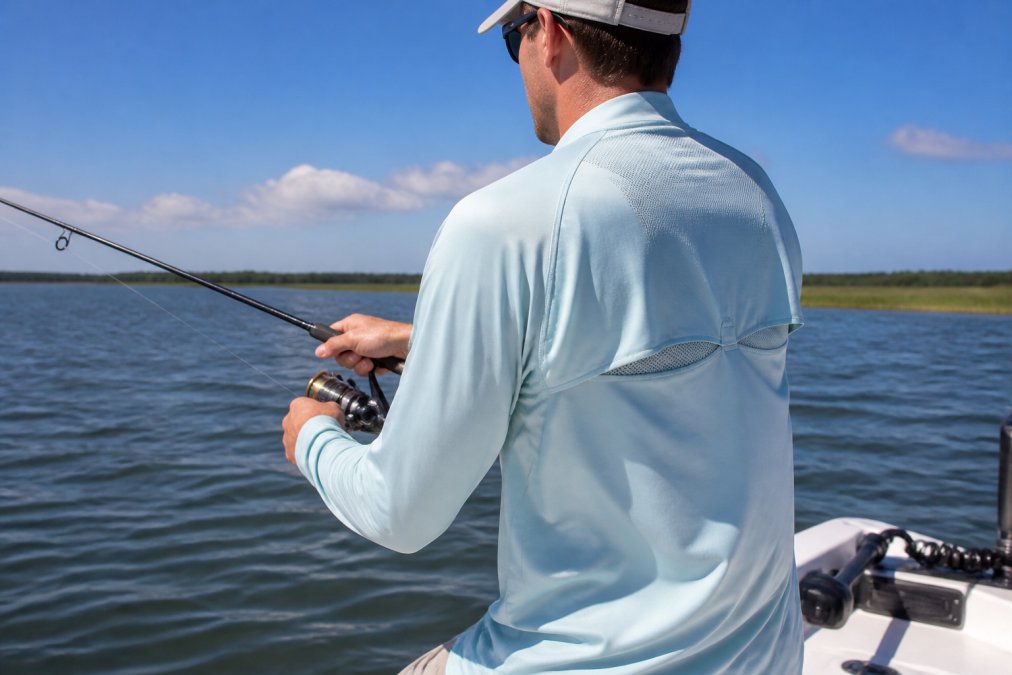
How breathability actually works in a fishing shirt
Airflow through a shirt depends on three things: fabric weight, weave openness, and where the vents sit. A typical summer performance fishing shirt lands around 110-150 gsm (grams per square meter). Push past roughly 170 gsm and you are into shoulder-season territory, where the shirt traps more heat than it releases. Below about 100 gsm, airflow improves but the fabric can go translucent when stretched, which quietly undermines the UPF rating.
Cooling features worth paying for
- Vented back panels that release trapped heat. Look for laser-cut perforations or a mesh yoke rather than a decorative print.
- Mesh lining at the yoke, which lifts the outer fabric off your shoulders so sweat can evaporate instead of pooling.
- Light colorways that reflect rather than absorb sunlight. A white or pale sand shirt runs measurably cooler in direct sun than a black one of identical fabric (pubmed.ncbi.nlm.nih.gov).
- A hood or neck gaiter for the back of the neck, an area people forget and the one that burns first on open water.
- Underarm gussets, which reduce the seam friction that turns a hot day into a chafing one.
What to skip
Heavy rubberized logos, double-layer chest pockets, and non-breathable waterproof coatings all defeat the point of a summer shirt. If a shirt feels slick and non-porous against your hand, it will feel the same against your skin at noon.
Layering Fishing Shirts for Cold Mornings and Hot Afternoons
Layering solves the temperature swing that defines most fishing days. A cold launch at first light turns into a hot afternoon, often within a few hours.
Build a three-part system:
- A moisture-wicking base layer against the skin
- A mid-layer fleece or light insulation for the morning
- A UPF 50+ fishing shirt as the outer shell
Sizing, Care and Sustainability: What Most Buyers Forget
These three details decide whether a shirt lasts one season or five, and they are the questions most buyers only ask after the return window closes.
Sizing and fit for real casting motion
Technical fishing shirts often run trimmer than casual tees, and the size letter tells you almost nothing about whether the shirt works when you cast. Measure three things before you buy:
- Chest, at the fullest point, with the tape level under your arms.
- Sleeve length, from the center back of the neck, across the shoulder, to the wrist bone.
- Torso length, from the base of the neck to the hip, so you know whether the hem stays put when you bend to net a fish.
A few fit problems show up again and again:
- Short sleeves that ride up when you raise your arms to cast. Articulated or raglan sleeves fix this; a standard set-in sleeve usually does not.
- A hem that pulls out of your waistband every time you bend. Look for a slightly dropped back hem.
- A shoulder seam that pulls across the chest when you reach forward. If the seam lifts off your shoulder, size up.
Care that protects the UPF rating and the wicking finish
UPF protection built into the fabric structure survives washing far better than a chemical finish, but both degrade faster with the wrong habits.
- Wash in cold water on a gentle cycle.
- Skip fabric softener and dryer sheets. They coat the fibers and block the wicking action on the inner face.
- Turn the shirt inside out before washing to protect that inner face.
- Air dry when you can. If you use a dryer, keep it on low.
- Avoid chlorine bleach, which weakens fibers and shortens the life of the rating.
- Retire any shirt that has thinned to the point of being see-through when held to light. Stretch also matters: a shirt pulled tight against the skin lets more UV through than the same fabric worn loose.
Sustainability: what to actually look for on the label
A growing share of performance apparel uses recycled polyester, and some manufacturers publish lower-impact dye processes or bluesign-approved fabrics. For anglers who care about the waters they fish, the fiber content tag is a reasonable place to start. Recycled polyester performs close to virgin polyester in wicking and durability, so the choice rarely costs you function.
Conclusion
The gap between a shirt that works and one that doesn't comes down to fabric, fit, and honest labeling. Buy for the UPF rating and the weave, not the logo.
Frequently Asked Questions
What is special about fishing shirts compared to a regular t-shirt?
Fishing shirts are built around three jobs: blocking UV rays, moving sweat away from your skin, and letting air circulate so you stay comfortable through a long day on the water. A cotton t-shirt soaks up water, clings when wet and offers little sun protection. A proper fishing shirt uses technical fabric with UPF 50+ rating, moisture-wicking properties and often a vented back or mesh lining. That combination keeps you cooler and reduces sunburn risk during extended exposure.
Do fishing shirts actually keep you cool in hot weather?
Yes, when the fabric is designed for it. Lightweight, breathable weaves with moisture-wicking finishes pull sweat to the surface where it evaporates, and vented panels release trapped heat. Long sleeves can feel counterintuitive in summer, but they block direct sun from your arms, which often feels cooler than bare skin under intense UV. Look for quick-dry fabric, mesh lining and a relaxed cut that allows airflow rather than clinging.
Are long-sleeve fishing shirts better than short-sleeve?
It depends on your exposure and the season. Long sleeves give full arm coverage, so they suit all-day sun, offshore trips and anglers who burn easily. Short sleeves feel lighter and suit short sessions, warm evenings or anglers who prefer maximum airflow. Many people keep both: long sleeve for peak sun and open water, short sleeve for quick trips. A hooded fishing shirt with a neck gaiter adds face and neck coverage when the sun is relentless.
Does UPF 50+ protection fade after repeated washing?
Quality UPF 50+ fishing apparel holds its rating far better than cheap alternatives, but care matters. Wash in cold water, avoid fabric softener and skip the dryer when you can, since heat and abrasion break down fibers over time. Follow the care label, and if the fabric becomes stretched thin or see-through when held to light, its protection has likely dropped. Buying from brands that test and label their UPF rating gives you a clearer baseline than unrated shirts.