

Table of Contents
- Best Sun Protective Fishing Shirts at a Glance
- How to Choose the Right UPF Rating for Your Fishing Shirt
- UPF Fishing Shirts: Understanding Protection Standards
- Long-Sleeve Fishing Shirts for Maximum Coverage
- Moisture-Wicking Fishing Shirts for Hot Water Days
- Hooded Fishing Shirts: Extra Protection for Face and Neck
- Durability and Care: Maintaining UV Protection After Washing
- Conclusion
- Frequently Asked Questions
Last Updated: October 5, 2026
Best Sun Protective Fishing Shirts at a Glance
Spending six to ten hours on the water makes sun protection essential, not optional. The best sun protective fishing shirts combine UPF50+ protection with breathable, moisture-wicking fabrics and practical features like hoods and thumb loops.
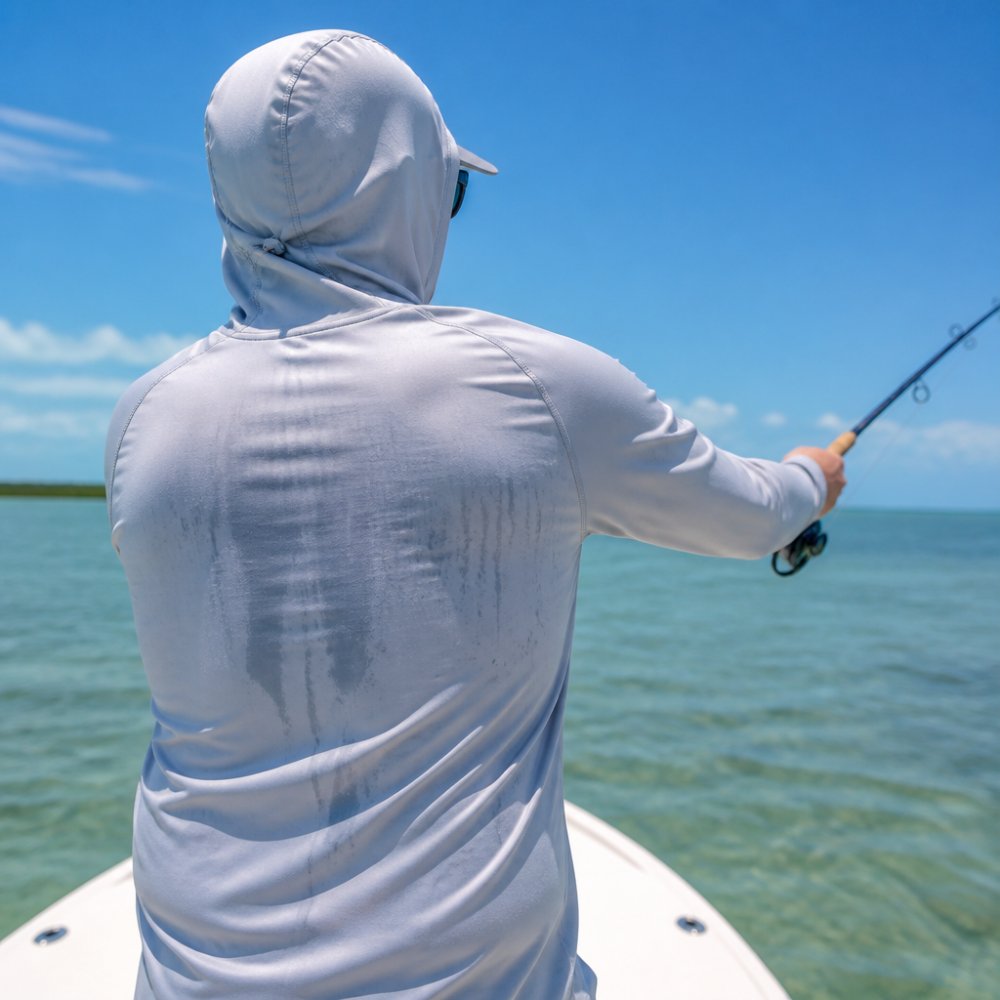
At DeepCast Fishing, our apparel line is built on one principle: protection that doesn't feel like a wetsuit in July. These shirts deliver serious UV defense while keeping you cool and focused on the fish.
| Shirt | Best For | Key Feature | Price |
|---|---|---|---|
| BlueTail Hooded UV Shirt | All-day sun exposure | Integrated hood, lightweight | $79.99 |
| UV Performance Tee | Everyday versatility | Blocks 98% UVA/UVB rays | $79.99 |
| Deep Cover UV Shirt (CAMO) | Stealth fishing | Camouflage design | $74.99 |
| Fire Line Hooded UV Shirt | Maximum coverage | Full hood, thumb loops | $79.99 |
How to Choose the Right UPF Rating for Your Fishing Shirt
UPF (Ultraviolet Protection Factor) measures how effectively a fabric blocks ultraviolet rays. A UPF50+ shirt blocks roughly 98% of UVA and UVB rays, the radiation that causes sunburn and skin damage.

UPF ratings only go up to 50+; there's no UPF100. Once you hit UPF50+, you're getting maximum practical protection. The gap between UPF30 and UPF50+ is real but marginal, about 97% versus 98% of rays blocked.
Proper care matters, especially with frequent saltwater exposure.
For fishing, we recommend UPF50+ as the standard. Hours of direct sun plus reflection off the water amplifies UV intensity, and UPF50+ gives a safety margin that matters on the water all day.
UPF Fishing Shirts: Understanding Protection Standards
A UPF rating tells you what a new, dry, properly fitted shirt did in a lab, not what it will do after a season of saltwater, sunscreen, and washing. Understanding that difference separates a smart purchase from a disappointing one.
What the rating actually measures
UPF measures how much UV radiation passes through fabric to your skin. A UPF50 fabric allows roughly 1/50th of UV radiation through, which is why UPF50 and UPF50+ are described as blocking about 98% of UVA and UVB rays. Ratings above UPF50+ aren't used in standard labeling, so UPF50+ is the top of the practical scale.
Testing is done under controlled conditions: fabric stretched to a specified tension, measured dry, evaluated in a lab. Useful benchmark, but not the same as a shirt on your back at 2 p.m. on a clear day.
The four things that change real-world protection
- Fit and stretch. Fabric pulled tight lets more UV through as the weave opens up. A snug shirt protects less than the same shirt worn with ease, which is why a relaxed fit is often better for long days in the sun.
- Wetness. Water reduces UV protection in many fabrics, so a soaked shirt is not equivalent to a dry one. Quick-drying technical fabrics recover faster, which is why they beat cotton on the water.
- Abrasion and wear. Rubbing against a rod butt, seat, or PFD thins fibers over time. Shoulders, elbows, and lower back lose protection first.
- Washing and care. Detergent residue, fabric softener, and hot water all affect performance. Softeners coat fibers and reduce UV blocking and moisture-wicking; bleach and harsh detergents degrade the fabric itself.
How to choose a UPF rating for fishing
For most anglers, UPF50+ is the sensible target. Direct sun plus reflection off the water increases the effective UV dose. UPF30 or UPF40 beats nothing, but the price gap to UPF50+ is small and the protection difference over a full day is meaningful.
In intense conditions, such as high altitude, tropical latitudes, or long offshore runs, treat UPF50+ as the floor and lean on coverage. A UPF50+ short-sleeve shirt still leaves forearms, neck, and ears exposed; a long-sleeve hooded shirt with thumb loops covers far more skin. Rating and cut work together.
Care that preserves protection
- Wash in cold or cool water with a mild detergent.
- Skip fabric softener and dryer sheets entirely.
- Air-dry when you can; if you use a dryer, choose low heat.
- Rinse after saltwater exposure to remove salt and residue.
- Inspect high-wear areas each season for thinning or pilling.
The fabric usually outlasts the protection, so replacing a heavily used shirt every few seasons is reasonable, not wasteful.
Health Canada sun safety guidance on UV protection and skin cancer prevention
Long-Sleeve Fishing Shirts for Maximum Coverage
Long sleeves are non-negotiable for serious anglers. They protect forearms that spend hours in direct sun and reflect UV off the water.
The trade-off is breathability: long sleeves trap heat. Fabric technology is crucial here. A moisture-wicking long-sleeve shirt moves sweat away to evaporate; cotton holds moisture against your skin and feels heavy.
Look for technical fabrics, polyester blends, nylon, or specialized synthetics. The BlueTail Hooded UV Shirt and Fire Line Hooded UV Shirt both use lightweight technical fabrics designed for water activities.

Long sleeves also guard against sharp line, hooks, and sun-exposed rocks or coral. Even without UV concerns, they're practical safety gear.
Moisture-Wicking Fishing Shirts for Hot Water Days
Moisture-wicking pulls sweat away from your skin and disperses it across the shirt's surface to evaporate. It's what separates a comfortable fishing day from a miserable one.
Cotton absorbs sweat and holds it against your skin, leaving you clammy and heavy. The UV Performance Tee uses advanced moisture-wicking technology to keep you dry even in high heat.
BlueTail Hooded UV Shirt UPF50+ →
Casting for hours in full sun generates significant heat. A moisture-wicking shirt lets that heat escape; a non-wicking shirt traps it and you overheat.
Breathability and moisture-wicking go hand in hand: air circulating through the weave accelerates evaporation. Look for open weaves or mesh panels in high-heat areas like the back and underarms.
Hooded Fishing Shirts: Extra Protection for Face and Neck
Your face, ears, and neck are the most sun-exposed and sun-sensitive areas on the water, and the hardest to cover with a standard shirt. A hooded fishing shirt closes that gap, but the hood alone isn't complete. The strongest setups treat coverage as a system: hood, collar, sleeves, thumb loops, and accessories working together.
What a good fishing hood actually does
A well-designed hood covers the ears, back of the neck, and sides of the face. A floppy hood that sags forward can block your view of the water, line, or a rising fish.
Hoods also need to stay put in wind. On an open boat or kayak, a loose hood flaps, exposes your neck, and distracts.
The coverage system: hood, collar, thumb loops, and accessories
A hood covers the top and back of your head, but not everything. Think in layers:
- High collar or gaiter-compatible neckline. A stand-up collar covers the front of the neck when the hood is down. If the collar is low, add a neck gaiter; pulled over the chin and lower face, it's the biggest upgrade for anglers who burn easily on the neck and jaw.
- Thumb loops. Small fabric loops at the cuff keep the sleeve pulled over the back of the hand when you cast, paddle, or hold a rod. Without them, sleeves ride up and expose the wrist and top of the hand, two spots that burn fast and are easy to miss with sunscreen.
- Sun gloves. Thumb loops partially cover the back of the hand; fingerless sun gloves cover the rest, including fingers and knuckles. For offshore or all-day exposure, gloves plus thumb loops are the practical combination.
- Buff or face covering. A lightweight neck gaiter or buff worn under the hood gives near-total coverage of ears, cheeks, and nose. Common on offshore trips and in tropical or high-altitude fisheries where reflected UV is intense.
Hood design trade-offs to weigh
More coverage usually means more heat. A full hood with a brim and high collar traps warmth around the head and neck. In hot, humid conditions, some anglers prefer a lighter hood with a lower collar and rely on a gaiter for the front of the neck, venting heat when working hard and pulling the gaiter up when stationary.
Visibility is the other trade-off. A brim that's too long or floppy blocks peripheral vision, which matters when watching a fly line, bobber, or downrigger.
Durability and Care: Maintaining UV Protection After Washing
UPF protection degrades with washing, but proper care slows it significantly. Here's how to keep your fishing shirt performing for years.
Wash in cold water, since hot water breaks down UV-blocking compounds. Use mild detergent and avoid bleach, which damages fibers and reduces UV-blocking capacity. Air-dry when possible; machine drying generates heat that accelerates degradation.
After saltwater fishing, rinse with fresh water before washing. Salt deposits damage fabric and reduce breathability, and a 30-second rinse significantly extends the shirt's life.
Conclusion
Choosing the right sun protective fishing shirt comes down to three factors: UPF rating (aim for UPF50+), coverage (long sleeves and hoods matter), and fabric technology (moisture-wicking beats cotton every time).
At DeepCast Fishing, we design every shirt around the reality of spending entire days on the water. Our UPF50+ hooded shirts block 98% of harmful UVA and UVB rays while staying lightweight and breathable in hot conditions.
Ready to protect yourself properly? Explore our full collection of BlueTail Hooded UV Shirt UPF50+, UV Performance Tee options, and hooded designs built for serious anglers.

Frequently Asked Questions
What UPF rating should a fishing shirt have for all-day sun exposure?
UPF50+ is the gold standard for serious anglers. UPF50+ blocks 98% of harmful UVA and UVB rays, providing the highest level of protection available. If you're spending 6+ hours on the water regularly, UPF50+ is worth the investment. Lower ratings (UPF 30-40) offer decent protection but allow more UV penetration. For fishing, where reflection off water intensifies sun exposure, UPF50+ delivers the protection your skin needs during long days casting and retrieving.
Do sun-protective fishing shirts lose their effectiveness after washing?
Quality sun-protective shirts maintain their UPF rating through proper care. The UV-blocking properties are built into the fabric itself, not a coating that washes away. However, repeated washing, high heat, and chlorine exposure can gradually reduce effectiveness over time. To preserve protection, wash in cool water, avoid high heat drying, and minimize bleach use.
Are long-sleeve fishing shirts cooler than short-sleeve in hot weather?
Yes, when made from the right fabric. Lightweight, moisture-wicking long-sleeve fishing shirts actually keep you cooler than short sleeves because they block direct sun and allow sweat to evaporate efficiently. The fabric's breathability matters more than sleeve length. Technical fabrics used in quality sun protective shirts are designed to move air and wick moisture away from your skin, preventing the heat buildup that cotton traps. This is why serious anglers choose long-sleeve UV shirts even on hot days.
What makes a fishing shirt different from regular UV-protective clothing?
Fishing shirts are engineered for water-specific demands: saltwater and freshwater durability, quick-drying fabric, extended coverage (hood, high neck, thumb loops), and performance features like moisture-wicking. Regular UV clothing prioritizes everyday comfort; fishing shirts prioritize extended sun exposure, water contact, and the physical demands of casting and retrieving. Fishing-specific designs also account for fit over layers and accessibility for gear, making them purpose-built for anglers rather than general outdoor use.